
No Data, No Party: Why SEA 2025 Will Fail Without Server-Side Tracking and Data Strategy
Hand on heart: How much time do you invest in polishing your ad copy versus your data infrastructure? If the balance tips heavily in favor of the copy, you're heading for a problem.
The era of manual campaign management is coming to an end. We are in the age of "black box" algorithms. Campaign types like Performance Max or Demand Gen autonomously decide when, where, and to whom they display an ad. Yet, these AI systems have an Achilles' heel: they are blind without data.
In this deep-dive article, we explore why so-called "Signal Loss" (data loss) is the biggest threat to your ROI—and with which technical setup (Server-Side Tagging, Enhanced Conversions, OCI) you can outpace the competition.

1. The Status Quo: The Silent Death of Cookies
For years, client-side tracking (via the user's browser) was the gold standard. A pixel was loaded, a cookie was set, the purchase was measured. But this foundation is not just crumbling; it has already collapsed.
The reason for this is a "perfect storm" of three factors:
- Regulation (GDPR & DMA): The EU's Digital Markets Act (DMA) forces gatekeepers like Google to implement stricter consent processes. Without explicit consent, data can no longer be used for profiling.
- Browser Restrictions (ITP & ETP): Apple's Intelligent Tracking Prevention (ITP) in Safari and Mozilla's Enhanced Tracking Prevention (ETP) in Firefox massively limit the lifespan of cookies. Fact: In Safari, many cookies are deleted client-side after just 24 hours or a maximum of 7 days. A user who clicks on Monday and buys the following Tuesday will not be attributed to the ad.
- Ad Blockers & VPNs: The prevalence of ad blockers in Germany is currently estimated at around 33% to 40%.
The consequence for your SEA: The algorithms of Google and Meta receive only incomplete feedback. If the system doesn't "learn" that click A led to revenue B, it will no longer bid on users like A in the future.
Reading tip
Google itself describes the necessity of seamless measurement in their article on the future of measurement.
2. The Solution: Server-Side Tagging (SST)
The answer to browser blockades is a shift in perspective. We must regain control. This is where Server-Side Tagging comes into play.
What is the difference?
In traditional tracking, the user's browser sends data directly to Google, Facebook, etc. This connection is vulnerable to blockers. With Server-Side Tagging, you first send the data to your own server (e.g., a Google Cloud Container). This server acts as a safe harbor. From there, you forward the data to the advertising platforms.
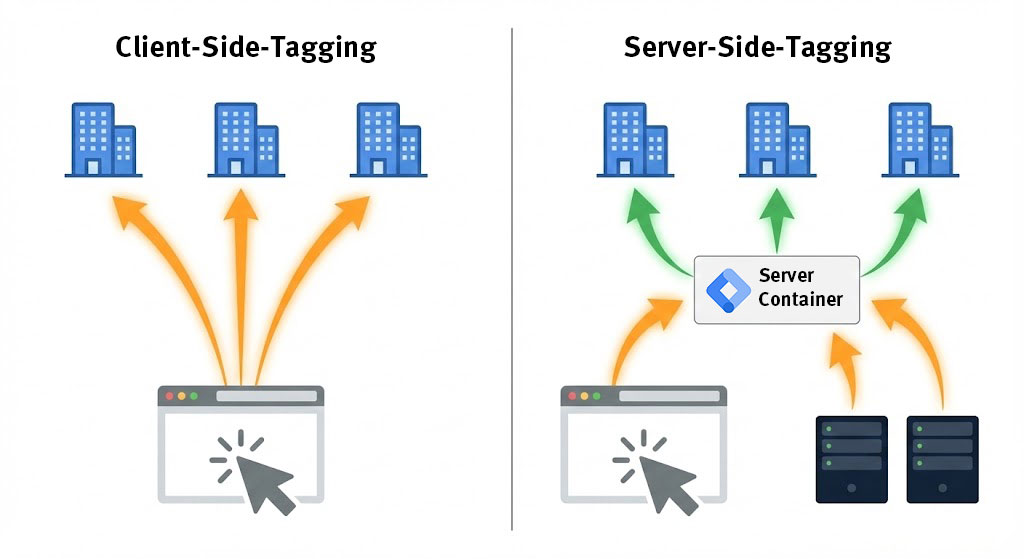
Why SST becomes a game-changer:
- Data Sovereignty: You decide what is shared. IP addresses can, for example, be anonymized before they go to Google.
- Bypassing Ad Blockers: Since the data request comes from your own domain (First-Party Context), many ad blockers do not recognize it as advertising.
- Site Speed (SEO Boost): With less JavaScript running in the user's browser, your site loads faster. A study by Deloitte already showed that improving load time by 0.1 seconds can increase the conversion rate in e-commerce by 8%.
3. Enhanced Conversions: Closing Gaps with First-Party Data
Even with SST, the problem of cross-device usage remains. A user sees the ad in the morning on the train on their iPhone but makes the purchase in the evening on a desktop. Without a login, they are often a ghost to tracking.
For this, Google offers Enhanced Conversions.
How it works: When a user fills out a form or makes a purchase on your site, they enter data (e.g., email address). This data is cryptographically encrypted (hashed, SHA-256) in the browser and sent to Google. Google matches this hash with its database of logged-in users.
The result: According to Google, Enhanced Conversions lead to an average conversion uplift of 5% in Search campaigns and up to 17% in YouTube campaigns. (Source: Google Internal Data, Global, 2021)
Those who do not activate this feature effectively leave up to 17% of their measured performance—and thus budget efficiency—on the table.
4. Mandatory: Consent Mode v2 & Data Modeling
Since March 2024, Google Consent Mode v2 is mandatory in the European Economic Area (EEA) for anyone wanting to use remarketing functions. Those who have not implemented it lose significant audience data.
But Consent Mode is more than just compliance. It is a data saver. Google uses AI modeling ("Conversion Modeling") to fill the gaps of users who have opted out of tracking in the banner.
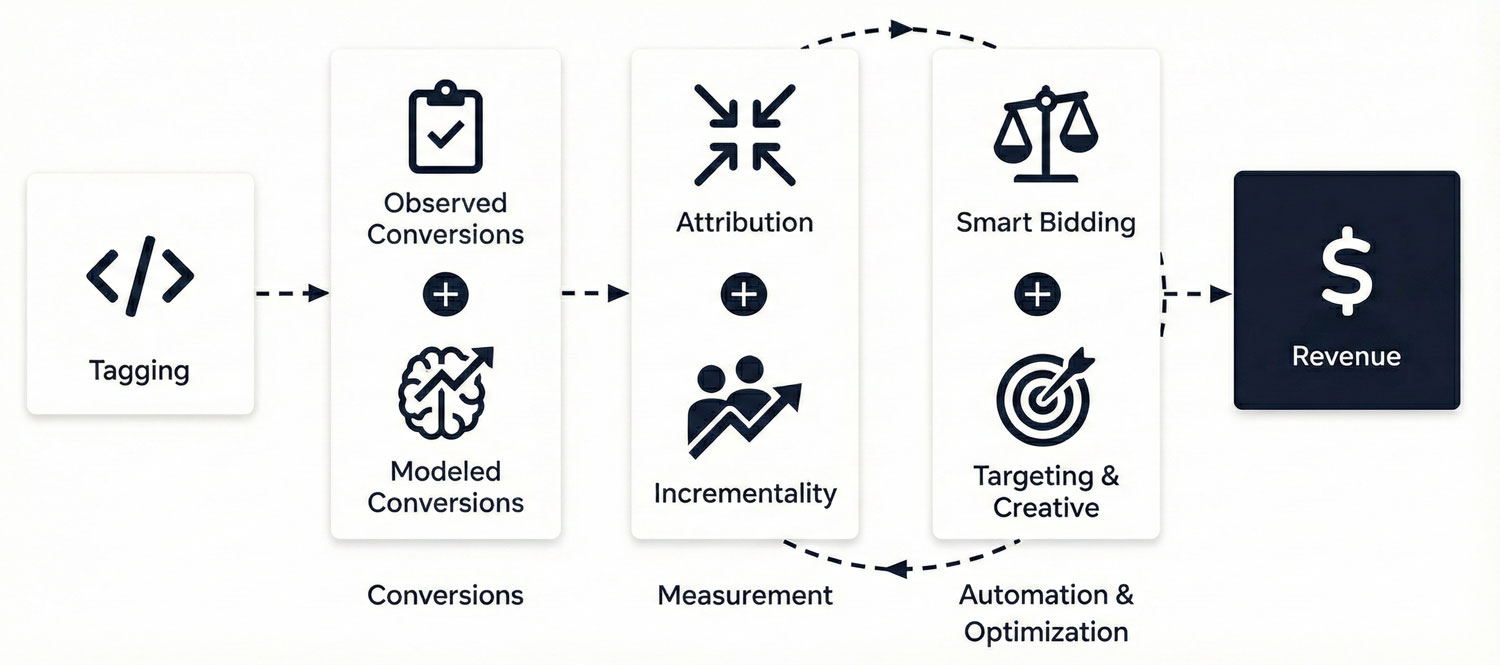
Through signals like device type, time of day, and browser (which are not personal data), Google can estimate how many conversions likely took place. Studies show that up to 70% of the seemingly lost ad click-to-conversion journey can be restored through modeling.
5. The Masterstroke: Offline Conversion Import (OCI)
If you generate leads (B2B, service providers, real estate), this point is the most important of the entire article.
Often, SEA managers optimize for the lead (filling out the form). But not every lead is good. If Google only learns who fills out forms, it will bring you more "form fillers"—but not necessarily paying customers.
With OCI (Offline Conversion Import), you connect your CRM (HubSpot, Salesforce, etc.) with Google Ads. You report back: "This lead from last week turned into a 10,000 € order today."
The effect: You train the algorithm on revenue and profit, not cheap clicks. This is called "Value-Based Bidding".
- Statistic: Companies that switch to value-based bidding strategies often see an increase in ROAS (Return on Ad Spend) by 14% with the same budget. (Source: Google/Boston Consulting Group)
Conclusion: Data Quality is the Biggest Lever for 2025
The message is clear: The technical setup is more important today than the perfect ad copy. In a world where AI takes over ad delivery, the winner is the one who provides the AI with the best data.
Your Action Steps:
- Check in the Google Ads account under "Goals" if Enhanced Conversions are active.
- Talk to your IT or agency about the status of Server-Side Tagging.
- Ensure that Consent Mode v2 is not only "implemented" but "Advanced" (with modeling) is running.
Don't wait until performance drops. Build the data foundation now that will future-proof your campaigns.